
Parimatch in Nepal: legality, identity and KYC evidence

Evidence signal: red. The available records do not establish that parimatch.com holds a Nepal licence. A dated Nepali report also names the service among betting platforms attracting local users and describes blocking activity. The signal concerns legal and access risk; it does not prove that every account, payment or identity request is fraudulent.
An identity mismatch should stop the KYC process
A request for a citizenship card, passport, selfie or bank statement should not be treated as routine when the identity of the recipient is unclear. For this service, the unresolved point is fundamental: the supplied evidence does not conclusively establish which legal entity operates parimatch.com for a person in Nepal. Regional entities and permissions may differ, and a foreign authorisation cannot simply be carried across borders.
Before uploading any document, compare four items: the hostname in the address bar, the legal name in the terms presented during registration, the name shown on the payment instruction and the entity named in the privacy notice. A difference does not automatically establish deception, but it prevents a reliable chain between the account, document recipient and payment beneficiary. Do not resolve the mismatch by relying on a logo, search advertisement, message from an agent or visually similar page.
| Item | Required match | Response to a mismatch |
|---|---|---|
| Hostname | Exactly parimatch.com, without added words or altered spelling | Stop and preserve the full address |
| Account holder | Your registered details and payment-account name | Do not use another person’s wallet or bank account |
| Legal entity | Consistent across terms, privacy notice and complaint details | Request clarification before sending documents |
| Document request | A stated purpose, recipient and handling policy | Do not send extra files merely through chat |
Legal status in Nepal: no online approval established
No Nepal licence for the exact domain was located in the supplied records. The official Casino Rules 2082 text concerns the physical-casino framework; it is not an online-operator whitelist. Its existence therefore cannot be used to claim that an offshore website is authorised to accept online play from Nepal.
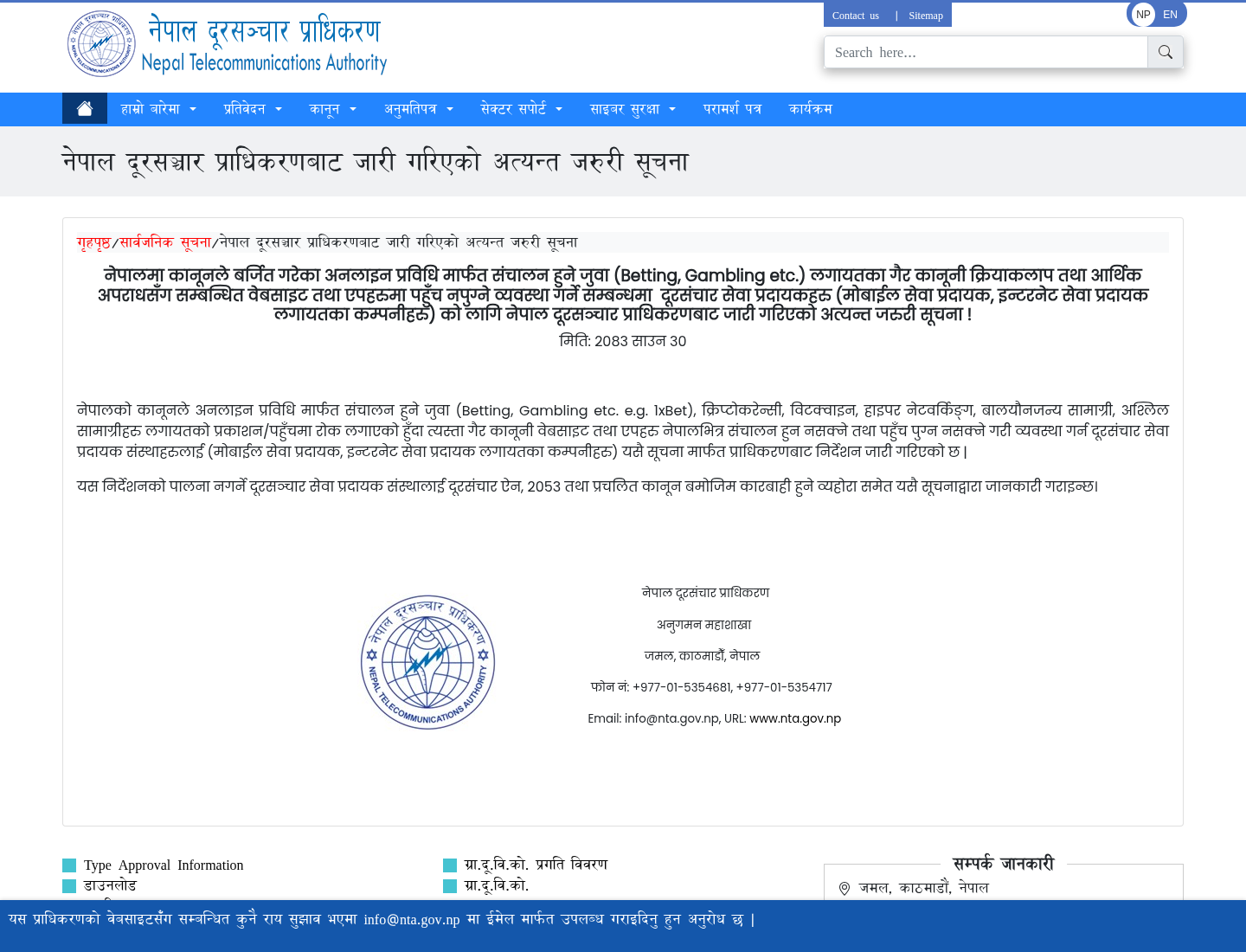
The Nepal Telecommunications Authority record directs service providers to prevent access to illegal betting and gambling sites and names 1xBet as an example. Although that direction does not name this brand in the supplied claim, it establishes the broader official restriction context. Separately, the 31 March 2026 report expressly names the reviewed service among platforms that attracted Nepali users and reports blocking activity.
| Evidence | Supported conclusion | Unsupported conclusion |
|---|---|---|
| Casino Rules 2082 | Nepal has an official physical-casino framework | That parimatch.com is approved online |
| NTA direction | Providers are directed to restrict illegal betting and gambling sites | That every named or accessible page has the same operator |
| 31 March 2026 report | The brand is named in local-use and blocking context | That every customer transaction is a scam |
For a fuller distinction between domestic rules and foreign credentials, consult the Nepal licence and law guide. A foreign licence, if shown elsewhere, would still require verification against its issuing register, exact entity and exact permitted domain. None has been attributed to Nepal here.
Is Parimatch a scam or legitimate?
The evidence supports neither a blanket fraud accusation nor a claim of Nepal legitimacy. “Legitimate” can refer to several different questions: whether a brand exists, whether a particular company is licensed somewhere, whether the exact hostname belongs to that company, whether Nepal permits the activity, and whether an individual withdrawal is paid. Those questions cannot be collapsed into one verdict.
The red assessment is based on corroborated adverse context: a Nepali report names the platform and describes blocking activity, while the official legal material supplied does not identify an online approval route for this domain. That combination creates a substantial legal, access and recovery risk for users in Nepal. It is not evidence that a specific employee stole funds, that every identity request is abusive or that every balance will be withheld.
There is also no supplied withdrawal test, account audit or verified customer ledger. Claims about fast payouts, reliable bonuses, game fairness or successful dispute resolution would therefore exceed the record. User comments, screenshots and agent messages may help identify what to investigate, but they cannot replace a regulator entry, contractual record or payment trace.
Exact domain and clone checks
The assessed hostname is parimatch.com. A similar colour scheme, copied logo or familiar sign-in screen does not establish that another hostname is connected to it. Clones can add a prefix, replace a letter, use a different top-level domain or send users through a shortened link. An agent-controlled page may also present payment details that cannot be tied to the entity in the website terms.
Type or inspect the hostname character by character. Check it again after every redirect and before entering a password, one-time code or document. A padlock only indicates an encrypted connection to the displayed hostname; it does not prove a Nepal licence, honest ownership or safe withdrawals. Do not reuse a password from email, banking or another betting account.
Preserve the complete address, not only a cropped screen. Useful evidence includes the date and Nepal time, the page title, the legal name displayed, the payment recipient and any redirect sequence. If the hostname changes during deposit or verification, record both addresses. Do not continue merely because a support message says that a “regional” or “backup” address is normal.
Payments and recipient-name checks
No particular deposit method, bank, wallet or processing time is verified by the supplied records. Availability shown to one account may depend on location, account status or an intermediary. Consequently, a payment logo on a deposit screen should be treated as an interface claim, not confirmation that the payment provider endorses the gambling service or will reverse a disputed transfer.
The safest evidentiary test is whether the recipient name can be reconciled with the disclosed operator and transaction description. A personal name, unrelated merchant, changing QR code or instruction to split a transfer raises questions that should be answered before payment. Do not describe a gambling transfer as another purchase to bypass controls, and do not let an agent operate your wallet or remote-access your device.
| Record | Why it matters | Minimum detail |
|---|---|---|
| Deposit instruction | Connects the account to the requested recipient | Amount, currency, recipient and timestamp |
| Payment receipt | Shows the actual transfer path | Reference number and account name |
| Account ledger | Shows whether the deposit was credited | Before-and-after balance and status |
| Promotion terms | Identifies restrictions claimed at the time | Full terms, expiry and wagering conditions shown |
Payment options also carry different recovery paths, but none guarantees reimbursement. The payment-risk guide explains what records to retain. Never send an additional “tax”, “unlock fee” or “verification deposit” solely because a chat representative promises that it will release an existing balance; first obtain the contractual basis and independently verify the recipient.
Withdrawals: distinguish delay, verification and refusal
There is no documented withdrawal test in the evidence packet. It is therefore unknown whether a Nepal-based account can withdraw, how long a request takes, which limits apply or whether the payout must return through the deposit channel. A displayed estimate is not the same as a completed transfer.
When a withdrawal stalls, record the requested amount, request time, status changes and every reason supplied. Ask for the exact contractual clause if the operator cites identity verification, turnover, duplicate accounts, payment ownership or a prohibited location. Keep the original wording. Do not edit screenshots in a way that removes timestamps, account identifiers or transaction references.
A verification request can be legitimate in some regulated contexts, but it still requires a known recipient and a defensible purpose. Repeated requests for the same document, unexplained demands for unrelated financial records, or payment to release payment should be documented. Avoid cancelling and resubmitting a withdrawal merely on informal advice, because doing so may reset a timer or weaken the history of the original request.
KYC privacy limits and account ownership
Identity checks may expose a citizenship number, address, face image, signature and financial history. The supplied records do not establish the data controller, retention period, storage location or Nepal-specific complaint contact for the exact domain. Those unknowns increase the consequence of sending more information than necessary.
Use an account only in your own name. The registered account holder, payment sender and withdrawal beneficiary should align. Borrowed documents, edited files or another person’s wallet may create both account and evidentiary problems. Never send a one-time password, card PIN, wallet recovery phrase or email password as KYC material. These credentials are not identity documents.
Before submission, ask what document is required, why it is necessary, who receives it, how it will be transmitted and when it will be deleted. If redaction is permitted, conceal unrelated transaction details while preserving the name and information needed for the stated check. If redaction is rejected, request the reason in writing. Review the privacy guidance before sharing high-risk documents.
Building a complaint packet
A useful complaint is chronological and specific. Begin with the exact hostname and account identifier, then list deposits, bets or balance movements relevant to the dispute, the withdrawal request, verification submissions and responses. State the remedy sought, such as a status explanation, return of a particular amount or deletion of documents. Avoid broad accusations that cannot be tied to records.
| Part | Include | Avoid |
|---|---|---|
| Identity | Masked account identifier and your name as registered | Passwords, PINs and recovery phrases |
| Timeline | Dated events in Nepal time | Approximate claims where records exist |
| Money trail | Amounts, currency, recipients and references | Unrelated financial history |
| Correspondence | Complete messages and ticket numbers | Selected excerpts that remove context |
| Requested remedy | A measurable action and response deadline | Threats or unsupported allegations |
Send the complaint through a contact method displayed for the exact account and retain proof of submission. If there is no response, preserve that fact rather than inventing a conclusion. The complaint guide provides a neutral structure. If payment credentials, identity documents or device access may be compromised, contact the relevant bank, wallet provider or authorities through independently verified channels.
Evidence chronology and assessment method
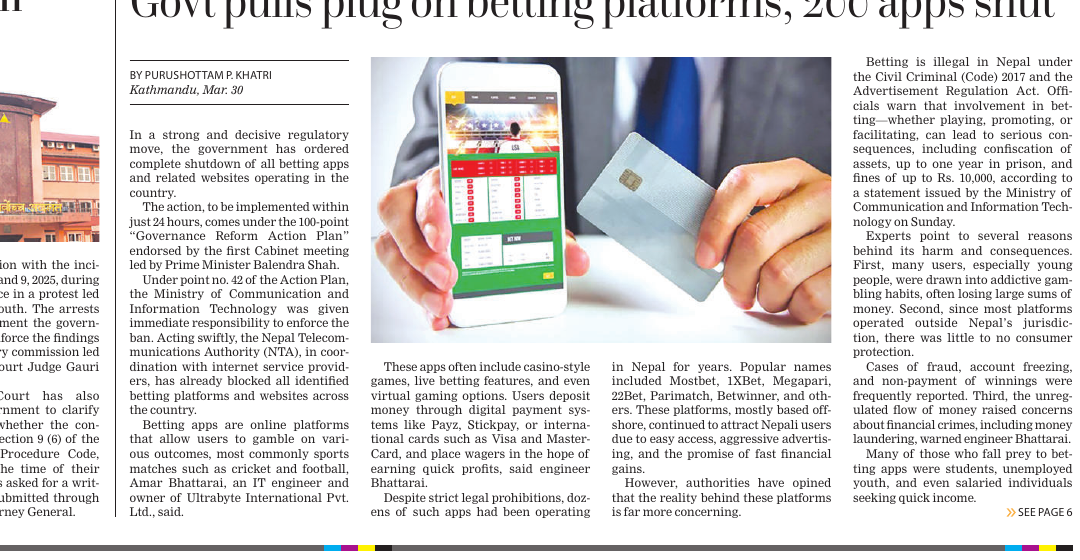
The dated sequence matters. The 31 March 2026 report names Mostbet, 1XBet, Megapari, 22Bet, Parimatch and Betwinner as platforms attracting Nepali users and reports blocking activity. By 31 August 2026, the three supplied records had been checked for this assessment. The NTA direction supplies primary official context for restricting illegal betting and gambling sites.
The method separates three questions: domain identity, legal authority and operational performance. A positive answer to one cannot fill a gap in another. Here, the exact operator remains inconclusive, no Nepal licence is evidenced, and no controlled payment or withdrawal test exists. The adverse local report and official restriction context justify red rather than amber, while the absence of transaction-level proof prevents a universal scam finding.
Evidence is also weighted by role. Official legal and regulatory material supports legal-context claims. The dated report supports the naming and blocking claims it contains. Neither source proves the outcome of an individual account dispute. The detailed approach is available in the evidence methodology.
Practical decision and unresolved risks
The central risk is not merely whether the homepage loads. Access can change, and an accessible address is not evidence of permission. A user may face interrupted access, uncertain recourse, identity exposure or difficulty connecting a payment recipient to a disclosed entity. These risks remain even if registration or deposit appears technically possible.
Before making any decision, require a verifiable entity-to-domain chain, a licence applicable to Nepal, clear document handling, payment details in the correct name and a complaint route that can be independently checked. The current packet does not supply that chain. Anyone who proceeds despite the red signal should not interpret the following destination as an endorsement or a finding of legality: Continue the check.
If gambling is causing financial pressure, chasing losses or secrecy, stop payments and use the responsible gambling resources. Urgent safety or financial distress calls for the urgent-help options, not another deposit.
Frequently asked questions
Is Parimatch legal in Nepal?
No Nepal licence for parimatch.com is established by the supplied records. Casino Rules 2082 concern the physical-casino framework and are not an online-operator whitelist. A 31 March 2026 report also names the platform in connection with Nepali users and blocking activity.
Does the red signal mean every Parimatch account is a scam?
No. The red signal reflects corroborated adverse legal and access context, combined with the absence of a verified Nepal licence for the exact domain. It does not prove that every transaction, account or identity request is fraudulent.
Which domain was assessed?
The assessed hostname is parimatch.com. Similar spellings, alternative top-level domains, shortened links and agent-provided backup addresses are not covered. Check the hostname after every redirect and before entering credentials, documents or payment details.
Are deposits and withdrawals verified?
No controlled deposit or withdrawal test was supplied. Available methods, processing times, limits, recipient identities and payout results therefore remain unknown. Preserve payment references, account-ledger entries and withdrawal-status changes if a dispute occurs.
Should I upload KYC documents?
Do not upload identity documents until the exact hostname, legal entity, document recipient, purpose and privacy terms align. Never provide a password, PIN, one-time code or wallet recovery phrase as verification material.
What should a complaint contain?
Include the exact hostname, masked account identifier, dated timeline, payment and withdrawal references, complete correspondence, relevant terms and the remedy requested. Keep originals and avoid sending unnecessary identity data or secret credentials.
Corrections and evidence updates
A correction should identify the precise statement challenged and provide a dated primary record connecting the exact domain, legal entity and relevant jurisdiction. Useful material could include an official register entry, regulator decision or complete contractual record. Promotional pages, copied licence images and unsupported agent messages are insufficient on their own.
Material can be submitted through the contact route. A later foreign licence would not automatically establish Nepal authorisation; its territorial scope, named entity and registered domains would still need checking. Likewise, one successful or failed withdrawal would document that event without proving universal performance.
Ministry of Culture, Tourism and Civil Aviation
Semrush
Tribuna